Thursday, May 23, 2013

Thanks Ed!


In terms of some of the things I run into in the shop, this isn't really that big of a problem. But I'm starting to be overrun by blades in the shop. 

I'm a big fan of Forrest blades, so I have several of them - there are always a few sharp ones in reserve, in case one gets damaged. But - it seems like I always end up with a ton of blades. 


 This blade holder was full,  


and so was this one.


Rip blades, combo blades, plywood blades, melamine blades, you name it, I probably have one. Or two. Or six. 


I wanted to drop off some blades to the sharpener, and I usually put them on a blade holder, but every one of them was full. Time to make one!


I grabbed a piece of plywood and set up the plunge router, to rout a handle slot. This 1-2-3 block helped me set the edge guide very quickly.  


I cut the slot in three passes, each one deeper than the one before. 


Sweet!


This was one of those 15 minute projects, but I still wanted to make it nice. So I placed the blade on the plywood and marked the area where the center hole would be drilled. 


I double-checked the depth with the washer and bolt. 


I wanted to round the corners and shape the plywood a bit, so I grabbed a compass. 

Whenever I grab a compass in my shop - or anyone grabs one - I think of my buddy Ed Tognetti. Years ago, I taught a Roll-Top Desk class; it ran 12 weeks and everyone completed a full sized tamboured desk. In the course of that class, we needed compasses for designing the upper part of the desk. At the next session, Ed showed up with a compass for everyone in the class. 

He passed away shortly after that, and I swear - every time I look at a compass in my shop, I think of him and miss him. 


I rounded the corners a bit, 


and then started loading the blades on to the holder. I put a sheet of cardboard between each blade, to protect the teeth.


The last thing I added was a piece of plywood with my card attached to it. 


If anyone needs a specialty blade - I've got one for you! Seriously, I am trying to find a home for some of these - free of charge. I don't use most of these, but I can't bear to throw them out. (No, I'm not giving away my Forrest blades, but I've got a lot of other brands.)


Before hanging it in the shop, I left a little note on the back of the holder.


Tuesday, May 21, 2013

A nifty little finish for you to make...

Two months ago, at our Sin City Woodworkers meeting, a new fellow brought an amazing table.  The top was a walnut burl, and he'd taken great care to flatten, sand and finish it. Just about everyone in the room had to touch the burl top - it was so gorgeous, we could barely keep our hands off of it. 

The finish on it was amazing - smooth and soft, without any sheen. When quizzed about what he used on the wood -  he explained that he's used a mixture of beeswax, oil and turpentine. 

Of course - a lively discussion ensued about custom blends of finishes - almost every woodworker I know makes his own custom blend. I've never loved the one I've mixed up - it uses turpentine and it's too smelly for my taste. 

Later - one of the members sent me a link to this video. That's one of the great things about this woodworking group - there's always a woodworking tip to be shared, or a technique to be demonstrated. Awesome. 


Saturday, May 18, 2013

Where do boxes come from?


This is a terrific video, forwarded to me by no less that four of my woodworking buddies here in town. The woodworking community here is growing every single week - at our last Sin City Woodworkers meeting, we had close to forty people in attendance! 

One of the best parts of that is the diversity of the group - we have carvers and furniture makers, toy makers and turners. Have a question about dovetails or dust collectors? No problem, someone is there to answer it for you.


Though this video is on the long side, I think it will keep you captivated. 

By the way, have you heard of this  Kickstarter campaign for a fellow making wooden pinhole cameras? 


Yes, the woodworking community here in Las Vegas is growing and evolving, but I love how the Internet allows us to become one larger global community. 


Wednesday, May 15, 2013

Can you imagine working the same job for 76 years?

Holy crap, this makes my back hurt. 

Here's a clip of a fellow who had been doing the same job for 76 years. It's a charming short video, and obviously - there is one important factor here. He loves what he does, so his "job" doesn't feel like work. 

But - can you just imagine doing a job that long? I mean - I love working with wood, and I often feel invigorated after spending a full day at the shop. But - if I worked with wood for 76 years, that means I'd still be doing it when I'm 90. 

Ummm.... no. 

Let's hope I'm retired by then! 

Sunday, May 12, 2013

It's OK to change direction in mid-stream...


When I said it was time to wrap up a few things around the shop, I wasn't kidding! Remember those four drawer fronts I've been working on for-fucking-ever?  The ones with the inset pulls 


and the carved areas?


To tell you the truth - once I started carving them - ugh.... I wasn't all that about them.

In fact, I really didn't like what was happening at all. You have no idea how tough it is to be working on a piece that you're not "feeling."


One of the best things about owning  every tool under the sun is that at least one of them will do what I want it to do - in this case - I used a router with a straight bit to eliminate the carved area.  Took it right out!


See, I wasn't satisfied with the carved area - it just didn't pull the piece together for me. I had been planning on using a little MilkPaint in the carvings, for some contrast. But instead -  I came up with a scathingly brilliant idea. 

(Ode to Hayley Mills...)

Why not inlay the area with a contrasting wood? There were a couple of details to consider - the grain of the wood had to run in the same direction as the drawer fronts. So I glued together a piece, and then cut and thickness-sanded the pieces to the correct dimension. 


They already look great - much more like what I envisioned. 


I needed to put a small chamfer, but the wood was so thin - it was a dicey operation. A router table and a scrap piece of wood to act as a hold-down was all I needed. 


Here's the routed edge. 


Before and after pieces. 


It's funny how I really hated working on this piece before, when I was carving it. Now that I was doing something that I really felt, this was coming together beautifully. 


Normally when you glue two pieces together, they will slip and slide around a bit, usually ending up mis-aligned.  But this hold down clamp secured the two pieces nicely. 


One side was applied almost flush- just a hair over the edge, so I would get a good glue joint. 


Here's an edge waiting to be cleaned-up.


One or two passes with a plane evened things up.


I trimmed the other edge flush on the tablesaw. 


Don't these look a hell of a lot nicer?


Last thing to do was chamfer the two long-grain edges.


Ready for sanding - and knobs. Knobs will be the next design decision... but this time, I feel much more equipped to make the right decision!


One last thing - Happy Mother's Day, mom! I miss you and wish we were hanging out together. And Happy Mother's Day to all the moms out there. 

Thursday, May 09, 2013

Broken Arms


Now that this last round of classes has ended, it's time to hop back onto a few jobs that are piling up. The first one has something to do with broken arms. 

No, not like this. 


Or this.


Or even this. 


It's more like this. 


And this.


Broken arms on chairs are one of the most requested repairs I do. A few weeks ago, my dentist called and said he had some chairs that needed repaired. Not my favorite job, but  - hey, that's why they call it work, right? 

Apparently the manufacturer of these chairs knew that this part of the arm was its weak spot. All of them were broken in the same place, and had mortises in the arms, with a loose tenon inside. An interesting thing though, was that the tenons weren't glued into place. At least I didn't have to dig them out, that made this repair a little simpler.  They all looked like this.  


I felt the best way to repair them was to cut new tenons and glue the arms back together.  Since the mortise was one-quarter inch square, I set the fence on the table saw up to cut a one-quarter inch rip. 


I made a vertical cut on a piece of wood, 


and flipped the board around, making a vertical cut,


 to create the square rip.


 I cut a few different pieces, each slightly larger, so that I'd get a good fit. (Richard W. makes fun of my stubby pencils, so I thought he'd like this shot.) I love stubby pencils!


 This is a perfect fit, so I cut them to length, and started my repairs. 


 These were miserable to clamp - I tried every which way to find a way to clamp them - making a special wooden block to support that big curve in the arm, but nothing worked, so I clamped them by hand.... yes, I put some glue on the pieces and held them together 
with my hands for about ten minutes, until the glue set up. 

Ah... the glamorous life of a woodworker. 


 But - in the end - the repairs were pretty solid. All four arms glued together perfectly. The best part was scratching this off of my "to-do" list. 


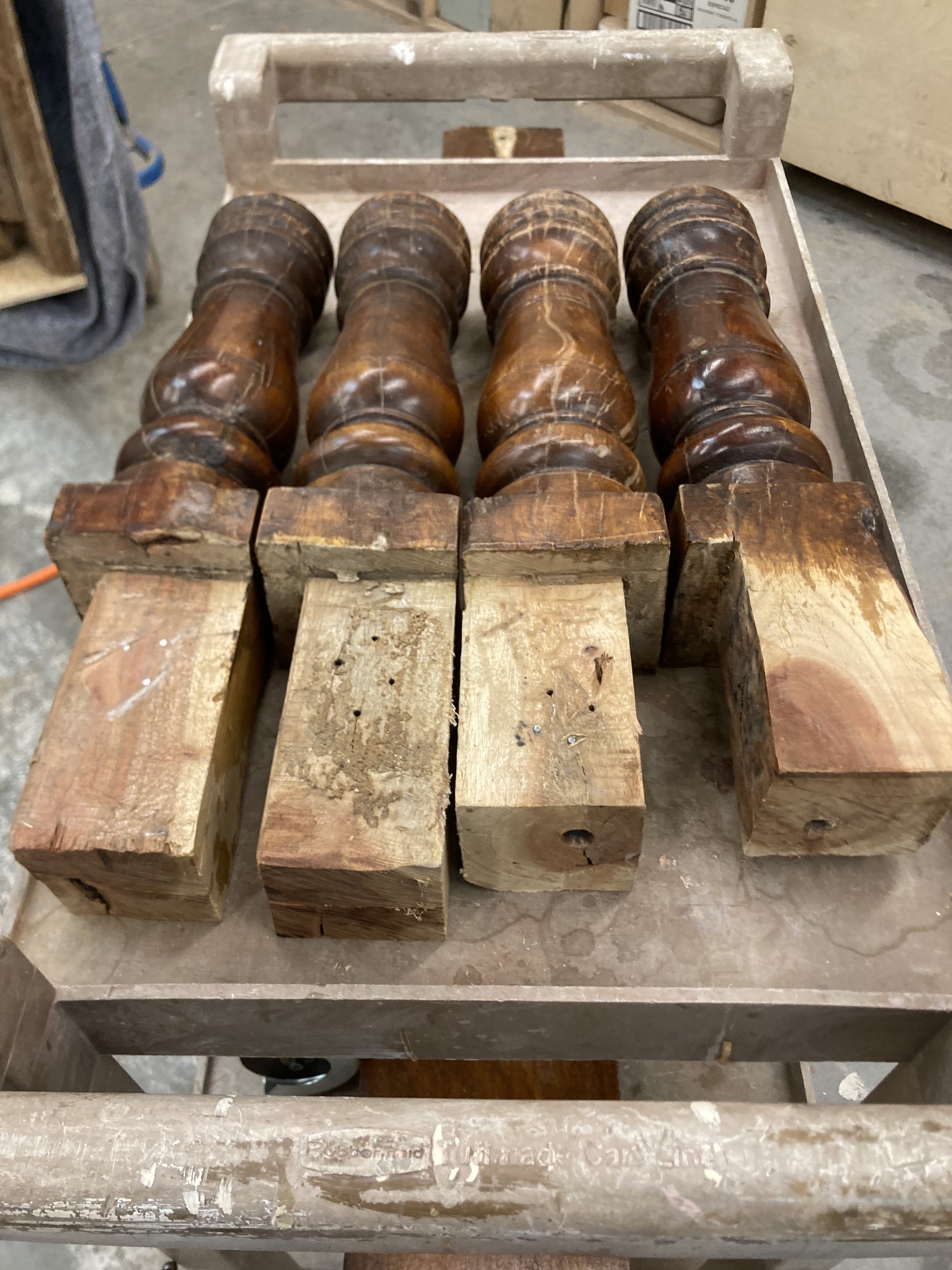
 I'm just happy I wasn't called to repair this chair leg!